
Statutes of the Dewender Foundation
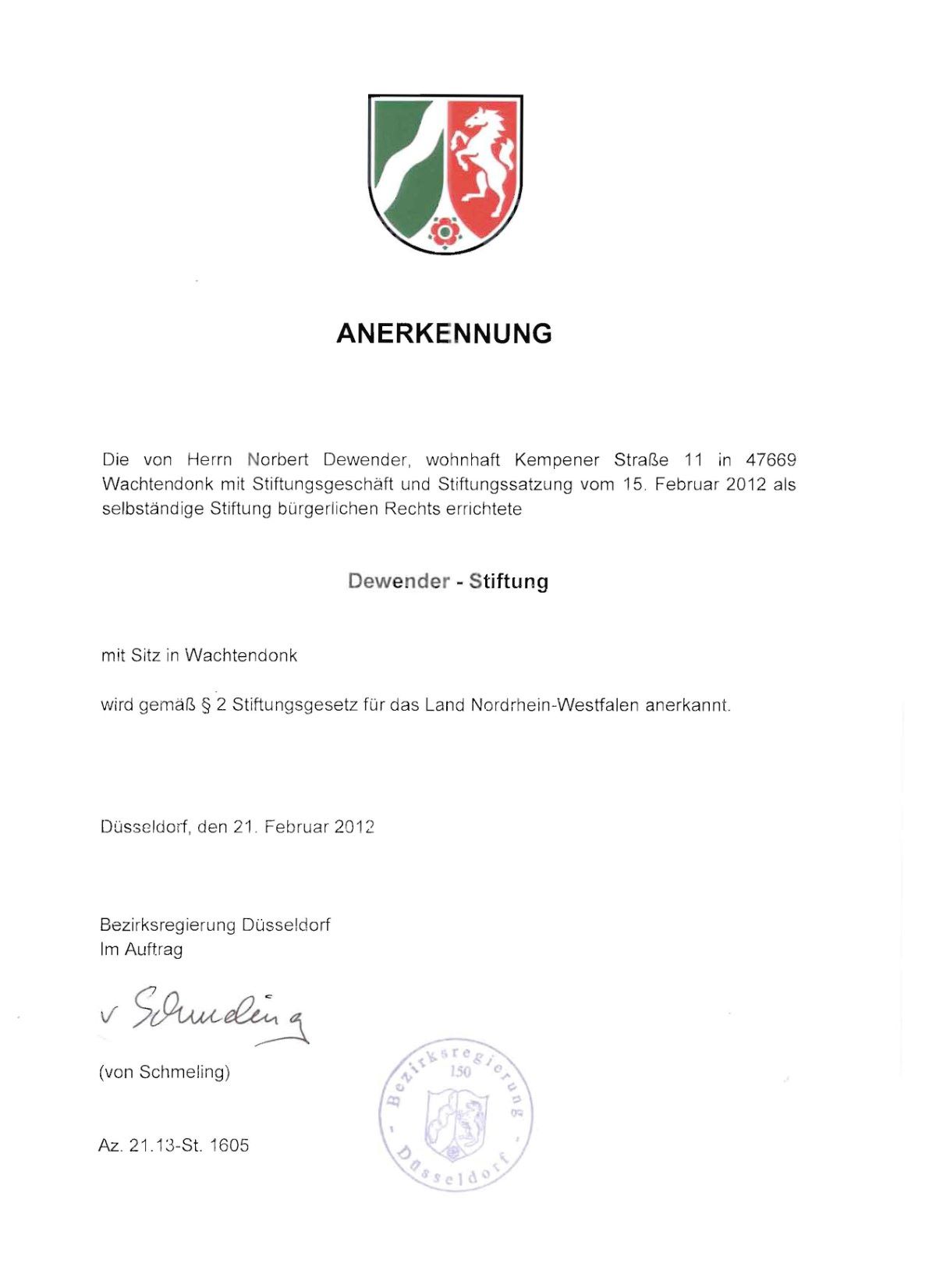
The Statutes constitute the legal foundation of the Dewender Foundation and define its purpose, organisational structure, and the use of its assets. The accompanying Certificate of Recognition issued by the District Government of Düsseldorf documents the Foundation's official recognition as an independent civil law foundation on 21 February 2012.This English translation of the Statutes of the Dewender Foundation is provided for information purposes only. The German version of the Statutes is the sole legally binding version. In the event of any discrepancy or inconsistency between the German and English texts, the German version shall prevail.
(1) The foundation bears the name "Dewender Foundation" (Dewender-Stiftung).
(2) It is a legally independent foundation under German civil law with its registered office in Wachtendonk, Germany.
(1) The Dewender Foundation, having its registered office in Wachtendonk, Germany, exclusively and directly pursues charitable purposes within the meaning of the section "Tax-Privileged Purposes" of the German Fiscal Code (Abgabenordnung – AO).
(2) The purpose of the Foundation is to raise and provide funds for the promotion of young people, education, vocational and personal development, sport, culture, and civic engagement through other tax-privileged organisations or public-law entities. In addition, the Foundation may pursue these purposes directly.
(3) The purposes of the Foundation shall be achieved in particular through:
- supporting organisations within the meaning of Section 58 No. 1 AO that wholly or partly promote the aforementioned purposes;
- awarding prizes and implementing other appropriate measures to recognise outstanding achievements that further the purposes of the Foundation and encourage others to follow such examples.
The purposes need not be pursued simultaneously or to the same extent. The promotion of these purposes includes the dissemination of results and activities through appropriate public communication and outreach.
(4) The Foundation shall act altruistically and shall not primarily pursue its own economic interests.
(5) The assets and income of the Foundation may be used solely for the purposes set out in these Statutes. A portion of the Foundation's income, not exceeding one-third thereof, may be used to provide reasonable support for the Founder and the Founder’s closest relatives, to maintain their graves at the cemetery in Wachtendonk, and to honour their memory.
(6) The Foundation may assume the trusteeship of dependent foundations (Treuhandstiftungen) and/or undertake the administration of legally independent foundations pursuing identical or similar purposes, provided that such activities remain compatible with the Foundation’s charitable status under German tax law.
(1) The Foundation's initial endowment is set forth in the Deed of Foundation and amounts to EUR 50,000 (fifty thousand euros).
(2) The Foundation's assets shall be preserved permanently and maintained in their full value. Subject to the approval of the competent Foundation Supervisory Authority, up to 15% of the Foundation's assets may exceptionally be utilised if the Foundation's purposes cannot otherwise be achieved and if the restoration of the withdrawn assets to the Foundation's assets is ensured within the following three years. Such restoration shall not materially impair the fulfilment of the Foundation's statutory purposes.
(3) The Foundation's assets shall be invested in a manner that is both prudent and income-generating to the greatest extent possible. Reallocations and restructurings of assets shall be permitted.
(1) Income generated from the Foundation's assets and contributions that do not increase the Foundation's endowment (donations) shall be used promptly for the fulfilment of the Foundation's purposes in accordance with the applicable provisions of German tax law.
(2) The Foundation may allocate all or part of its funds to a designated reserve where this is necessary to ensure the sustainable fulfilment of its tax-privileged statutory purposes and where specific objectives and timeframes have been established for the use of such reserve. Free reserves may be established and may be added, in whole or in part, to the Foundation's assets to the extent permitted under the provisions governing charitable organisations under German tax law.
(3) Contributions expressly designated by the donor for inclusion in the Foundation's assets (endowments or additions to the endowment) shall be added to the Foundation's assets. Testamentary gifts and bequests that have not been expressly designated by the testator for prompt use in furtherance of the Foundation's purposes may likewise be added to the Foundation's assets.
(4) No person may be favoured by expenditures that are unrelated to the purposes of the Foundation or by disproportionately high remuneration or other benefits.
Beneficiaries of the Foundation shall not have any legal entitlement to benefits, grants, or other support from the Foundation by virtue of these Statutes.
(1) The financial year of the Foundation shall be the calendar year.
(2) Within twelve months following the end of each financial year, the Foundation shall submit to the Foundation Supervisory Authority an annual statement of accounts, including a statement of assets, together with a report on the fulfilment of the Foundation's purposes.
The sole governing body of the Foundation shall be the Executive Board.
(1) The Executive Board shall consist of not fewer than one and not more than five members.
(2) The Founder shall serve as the sole member of the first Executive Board. The Founder shall act as Chair of the Executive Board for life.
(3) Members of the Executive Board shall be appointed for a term of three years. Reappointment shall be permissible.
(4) The term of office of a member of the Executive Board shall end upon expiry of the term of appointment. In such cases, the member shall remain in office until a successor has been appointed. A successor shall be appointed without undue delay. The office of a member of the Executive Board shall also terminate upon death or resignation, which may be effected at any time. A member of the Executive Board may be removed from office for good cause at any time by a resolution adopted by not less than three-quarters of the members of the Executive Board.
(5) Upon the departure of a member of the Executive Board, the remaining members shall appoint a successor by co-option.
Where the Executive Board consists of only one member, the departing member shall designate his or her successor or successors.
If the office of a member terminates before the expiry of the term of appointment, the successor shall be appointed only for the remainder of that term.
The Executive Board shall elect from among its members a Chair and a Deputy Chair.
(6) Members of the Executive Board shall be liable only for wilful misconduct and gross negligence.
(1) The Executive Board shall represent the Foundation in and out of court. It shall have the status of the Foundation’s legal representative. The Foundation shall be represented by the Chair of the Executive Board acting alone or by the Deputy Chair acting jointly with one further member of the Executive Board.
(2) Within the framework of the applicable Foundation Act and these Statutes, the Executive Board shall seek to implement the Founder’s intentions as effectively as possible. Its duties shall include in particular:
a) the administration of the Foundation’s assets, including the maintenance of proper accounting records and the preparation of the annual financial statements;
b) the adoption of resolutions concerning the use of income generated from the Foundation’s assets and all other income.
(3) The Executive Board may adopt Rules of Procedure governing its internal organisation and operations.
(4) Members of the Executive Board shall serve the Foundation in an honorary capacity. No financial benefits may be granted to members of the Executive Board. In particular, they shall receive no remuneration from the Foundation for their services. Subject to an appropriate resolution of the Executive Board, members shall, however, be entitled to reimbursement of reasonable expenses and costs incurred in connection with their activities on behalf of the Foundation.
(1) Resolutions of the Executive Board shall generally be adopted at meetings. The Executive Board shall constitute a quorum if more than half of its members are present. Unless otherwise provided in these Statutes, resolutions shall be adopted by a simple majority of the votes cast. In the event of a tie, the Chair shall have the casting vote.
(2) A member who is unable to attend a meeting may be represented by another member on the basis of a written authorisation. No member may represent more than one additional member.
(3) Provided that all members agree to this procedure, resolutions may, in urgent cases, also be adopted by written circulation procedure. This shall not apply to resolutions pursuant to Section 11(2) and (3) or Section 12 of these Statutes.
(1) The Executive Board shall resolve upon amendments to these Statutes that do not affect the purposes of the Foundation.
(2) If only part of the Foundation’s income is required for the fulfilment of the Foundation’s purposes, the Executive Board may adopt an additional purpose for the Foundation, provided that such purpose is related to the original purpose and that its permanent and sustainable fulfilment can be ensured without jeopardising the original purpose.
(3) Should circumstances change to such an extent that the fulfilment of the Foundation’s purposes no longer appears appropriate, the Executive Board may resolve to adopt new purposes for the Foundation. Any new purpose must likewise qualify as tax-privileged under German tax law.
(4) Resolutions pursuant to paragraphs (2) and (3) shall require a majority of three-quarters of the members of the Executive Board.
(5) The Foundation Supervisory Authority shall be notified of any amendment to these Statutes within one month of the adoption of the relevant resolution. Resolutions that materially alter the purposes or organisational structure of the Foundation should be adopted only after prior consultation with the Founder, where possible. Such resolutions shall require the approval of the Foundation Supervisory Authority.
(1) The Executive Board may, by a majority of three-quarters of its members, resolve to merge the Foundation with one or more other tax-privileged foundations or to dissolve the Foundation if circumstances no longer permit the permanent and sustainable fulfilment of the Foundation’s purposes and if the sustainable fulfilment of a purpose amended pursuant to Section 11(2) or (3) is likewise no longer feasible. Any new foundation resulting from such a merger must likewise qualify as a tax-privileged organisation under German tax law.
(2) Prior to the adoption of resolutions pursuant to paragraph (1), the Founder should be consulted, where possible. Such resolutions shall become effective only upon approval by the Foundation Supervisory Authority.
In the event of the dissolution or termination of the Foundation, or if its tax-privileged purposes cease to exist, the Foundation’s assets shall pass to a legal entity under public law or to another tax-privileged organisation for use exclusively for tax-privileged purposes within the meaning of Section 2 of these Statutes.
Without prejudice to any approval requirements arising under the applicable Foundation Act, resolutions concerning amendments to these Statutes and resolutions concerning the dissolution of the Foundation shall be notified to the competent tax authority (Finanzamt). In the case of amendments to these Statutes affecting the purposes of the Foundation, the opinion of the competent tax authority regarding the Foundation’s tax-privileged status shall be obtained in advance.
The Foundation shall be subject to the supervision of the District Government (Bezirksregierung) of Düsseldorf. The supreme Foundation Supervisory Authority shall be the Ministry of the Interior and Municipal Affairs of the State of North Rhine-Westphalia. Any approval and consent requirements imposed by the Foundation Authorities shall be observed. The Foundation Supervisory Authority shall, upon request, be provided at any time with information concerning all matters relating to the Foundation. Without being requested to do so, the Foundation shall submit to the Foundation Supervisory Authority, within twelve months following the end of each financial year, an annual statement of accounts, a statement of assets, and a report on the fulfilment of the Foundation’s purposes.
These Statutes shall enter into force on the date of service of the Certificate of Recognition of the Foundation.
Wachtendonk, 15 February 2012
Norbert Dewender
Founder
The German version of the Statutes of the Dewender Foundation is available for download here. The Certificate of Recognition issued by the District Government of Düsseldorf can be downloaded here.